

Last year, Generation Unlimited launched Time to Act: Preparing Youth for Work in an AI-Powered World. The report was informed by insights from 330,000 young people worldwide, who shared their perspectives on the potential and risks of artificial intelligence.
But since then, AI has advanced at a pace few could have anticipated. To understand how young people are navigating these changes, Generation Unlimited engaged four members of the Young People’s Action Team (YPAT), a network of changemakers who have led initiatives in climate action, gender equity, support for youth with disabilities, and the expansion of digital opportunities for marginalized communities.
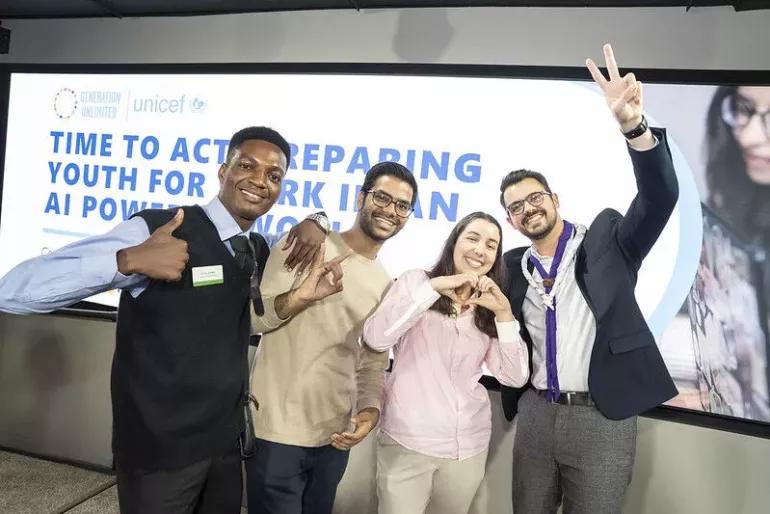
These four changemakers — Andrea Remes (Mexico), Shivansh Shalabh (India), Victory Ashaka (Nigeria), and Joaquín Parafita Rolando (Uruguay) — played a key role in launching Time to Act during the 2024 UN General Assembly, where they led discussions on the report’s four calls to action.
Six months later, Generation Unlimited reconnected with them to explore how their perspectives on AI have evolved — how their lived experiences have reshaped their understanding of its impact, influenced how they use AI in their daily lives, and shaped their views on the essential human skills needed in an AI-powered world.
Shifting Perspectives: From Skepticism to Strategic Use
Collectively, these young leaders reported significant shifts in their perspectives on AI since its broader integration into daily life. While many initially expressed skepticism or uncertainty about AI’s role in society, their deeper engagement has revealed its potential as a powerful tool to boost productivity, support learning, and promote equity — when used responsibly.
Shivansh, a Computer Science student at the University at Buffalo (UB), described his journey from initial apprehension to incorporating AI into his everyday life. He highlighted the dual reality of AI: its ability to enhance education and efficiency, but also its risk of deepening existing inequalities if access is not inclusive and democratic.
"AI accelerates learning for those with access but widens
gaps for those without it. Addressing data access and
digital divides must be a priority."
Shivansh Shalabh
Andrea, who is a co-founder of the educational platform Erandi Aprende, also emphasized the importance of accessibility, highlighting that "it’s not just about how to use AI. It’s about who gets to use it. Many marginalized communities lack reliable access, further widening the gap. AI needs to work for everyone, not just the privileged few."
"How well AI works depends entirely on how effectively you use it. The power lies in your prompts and questions." mentioned Joaquín, pointing out the importance of the user’s approach specially in his work as Chief Commercial Officer at Barbot Ingenieros.
Critical Human Skills in an AI Era
The YPAT leaders unanimously agreed that as AI reshapes the workforce, uniquely human skills become even more critical. These include not just the ability to think creatively and critically, but also to connect, adapt, and communicate with authenticity in a fast-changing world. As AI accelerates processes and information flow, what stands out more than ever is the irreplaceable value of emotional intelligence, perspective-sharing, and human-centered leadership. They advocate for investing in creativity, critical thinking, communication, and adaptability.
“If we lose our stories, we lose our authenticity,” said Victory, a poet and spoken word activist, emphasizing storytelling as a key human skill for preserving authenticity and humanity.
Shivansh called for innovation and adaptability, stressing that "the real spark of creativity and genuine innovation still resides in human capabilities."
Creativity and critical problem-solving are at the center for Joaquín, who shared that: "AI can support, but human creativity and questioning drive true innovation."
Andrea highlighted communication as irreplaceable: “Whether storytelling, writing, or discussion, AI enhances what we say but can’t replace our unique perspectives.”
Practical Applications of AI in Everyday Work
Beyond abstract discussions, these young leaders are actively integrating AI into their daily efforts — each in ways that reflect their unique roles and missions.
Andrea, a digital equity advocate, uses AI to quickly gather trustworthy information and sharpen her messaging when influencing policy or designing campaigns that bridge the digital divide. For Shivansh, a Computer Science student and developer, AI has become a technical partner — helping him debug code, streamline his programming, and master new languages more efficiently.
Victory, a spoken word artist and youth activist, brings AI into creative and academic spaces — refining visuals, enhancing presentations, and crafting compelling content that amplifies underrepresented voices. Joaquín, who focuses on entrepreneurship and inclusion, leverages AI to optimize business operations: from automating marketing tasks to experimenting with custom chatbots that support community outreach and accessibility.
Together, their experiences highlight how AI can be adapted across disciplines — powering everything from coding and campaigning to storytelling and strategic planning — while reinforcing the need for ethical use and a human-centered approach.
These young leaders share a common perspective: they don’t see AI as something to fear, nor as something to blindly embrace. They approach it with critical thinking and purpose, using it as a tool to strengthen their work and expand their impact across different contexts. Their reflections highlight a strong awareness of both the opportunities and risks of AI and demonstrate how young people are already translating the recommendations of the Time to Act report into meaningful action within their communities.
Bridging the Digital Divide and Centering Human Potential
As Andrea put it, “It’s not just about how to use AI, but who gets to use it.” This reminder underscores a critical gap: many marginalized communities still lack stable internet access, and with most AI tools requiring high-bandwidth connectivity, no amount of training will be effective if young people can’t access the tools in the first place. Bridging this digital divide means advocating for inclusive, low-bandwidth AI solutions that are truly accessible, ensuring no one is left behind in the AI-driven future.
Equipping youth with the right skills is just as important. In Time to Act, Generation Unlimited called for foundational GenAI skilling content and certification to prepare all young people for the future of work. In recent conversations with youth leaders, one skill consistently stood out: prompting. Joaquín emphasized that moving beyond surface-level interactions and using layered, strategic prompts is essential to unlocking AI’s full potential. As he described it, prompting is “gold,” a critical digital literacy that must be nurtured alongside technical and creative competencies.
Throughout these discussions, one theme remained clear: the enduring value of human skills. Victory highlighted storytelling and personal perspective as essential for preserving authenticity in a world increasingly shaped by automation. Shivansh, who regularly integrates AI into coding and learning, stressed that true innovation stems from human creativity. It is that creativity that will determine how AI is used, not the other way around.
Key Priorities for an Inclusive AI Future
- Close the digital divide with inclusive access. Ensure marginalized communities have consistent access to the internet and AI tools, with content available in multiple languages and formats that are culturally relevant.
- Scale free, job-relevant GenAI training. Develop and deliver accessible training programmes that equip young people with practical GenAI skills and certifications aligned with current labor market needs, especially in low- and middle-income countries.
- Strengthen uniquely human skills. Invest in skills that AI cannot replace — including creativity, storytelling, critical thinking, collaboration, emotional intelligence, and adaptability.
- Promote ethical and inclusive AI systems. Advocate for the development of AI that reflects diverse youth perspectives, mitigates bias, and ensures equitable outcomes for all.
The future of work will undoubtedly be shaped by AI. But it is young changemakers like Andrea, Shivansh, Victory, and Joaquín who are showing how it must also be shaped by human values, equity, and imagination. Through their leadership and lived experiences, they exemplify what it means to engage with technology critically and creatively.